
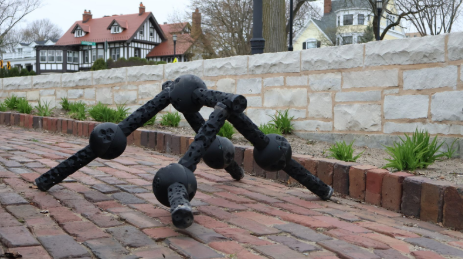
You heard it here folks, Northwestern University has recently showcased robots that utilize artificial intelligence to react based on their circumstances. Engineers at the university sought to make a robot with an autonomy that can survive anything. The team that has designed this robot calls this trait “athletic intelligence,” giving the abbreviation “ai” more than one meaning.
The shape and structure of this invention is unlike any robot you have seen. This adaptable robot is a composition of multiple robotic modular components that the team compares to Lego. Each robotic module includes a motor, battery, and computer. The modules snap together simply, hence the reference to the popular building block brand. Connected modules are referred to as a “legged metamachine.”
The legged metamachine has one main goal, to persist. Once out in the wild, the robot can reconfigure itself and change its movement pattern based on the conditions of its environment. Even if modules are separated from the main body of the legged metamachine, the main body remains functional and simply takes on new traits. Sam Kriegman, an assistant professor of Northwestern University and lead of the team, noted that two modules together can rearrange into approximately 500 configurations.
It’s these configurations that are driven by AI. The team at the university developed an “evolutionary algorithm.” The legged metamachine contains a program that mimics the process of mutation and natural selection. Kriegman and his team assigned a task to the program; “design a robot with efficient, versatile movement.” This is how the robot can determine the best fit form for its conditions or environment. It’s this algorithm that bypasses human design as it chooses more irregular shapes and movements that wouldn’t be chosen for the robot otherwise.
Interestingly enough, this isn’t the first time Kriegman has led a project of this kind. His lab and team had already developed an AI program that also designed a robot. This earlier program functioned in a similar manner, basing design off evolutionary processes. A less impressive robot was designed, only able to walk a small distance. Yet it was this study from 2023 that set a basis for the robot that evolves almost instantaneously.
As of right now, there is no definitive use for a robot of this kind. The legged metamachine’s sole physical capability is movement. Kriegman and his team hope that the program they have developed will create insight for why certain animals have evolved the way they have. “Why do animals have four legs? Is four really the best? We don’t know.” – Sam Kriegman. A machine with such intelligence is sure to show great potential in the future.