JUNE 2025
“I think you might have scoliosis,” the doctor told me. Which was weird, because I was there for a sore throat. I went to the doctor for a sore throat, and got told I have scoliosis. I thought nothing of it, I’ve had the screenings all throughout school and they never said I had it, why would I have it now? Besides, that doctor wasn’t my primary care anyway; he doesn’t know me. Whatever, I’ll go to the screening appointment.
AUGUST 2025
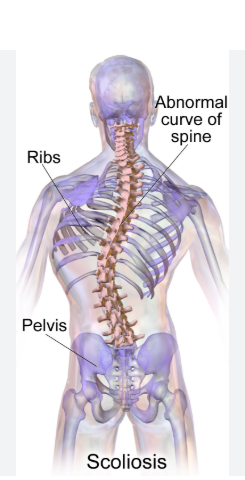
The X-Rays went by quickly, but it felt like I was waiting forever for the results. When they finally came in, it became apparent that the first doctor was right, I definitely have scoliosis. When I first saw the X-Ray, I instantly said, “that’s not my back.” I refused to believe it could possibly look like that. But it did. I was told I have a 38 degree curve at the top, and a 40 degree curve at the bottom, but I was also told that it is purely cosmetic. It causes me no adverse health effects. But it’s still a problem–I’m also told that I still have about a year of growth left, meaning there could be a chance it worsens. I want to be a firefighter, and a 40 degree curve or worse is an automatic disqualifier in the initial physical. I’m told I’ll have to start physical therapy, and I need to schedule an MRI.
SEPTEMBER 2025
First PT appointment of many. Looks like I’ll be there once a week for the next year. I’m given workouts to do every night at home, where I have to use a belt system to put tension on my spine while I flex certain muscles and breathe in a certain pattern. In a later appointment I get new workouts, where I have to flex and ‘expand’ almost every muscle in my upper body at once and hold it. It’s surprisingly difficult and way more intricate than it seems. But at the end of each session, I have a noticeable reduction in my curve, a temporary reduction, but a reduction. The hope is that consistent PT over the next year can at minimum prevent the curve from growing, and at best reduce the curve by a few degrees.
OCTOBER 2025
Come October, it’s time for the MRI appointment. What was supposed to be a 45 minute MRI at 3:00 ended up being an hour long MRI at 3:30, and of course I had to be at a soccer game for 4:30. The MRI sucked, it’s loud and after a little bit I became restless. But I stuck it out, and the results came back perfect; my spinal cord isn’t affected and is at no risk for further damage. So now, I have to play the long game. I have to be committed to daily and weekly physical therapy, and consistently working out, because it’s not just about getting stronger anymore. It’s about my future, fulfilling my dreams, and getting my dream job. Giving up isn’t an option.
I never found out why my throat hurt either.
FACTS ABOUT SCOLIOSIS
Scoliosis is surprisingly common, with about 3 in 100 people having it in the United States. About 80% of scoliosis cases are idiopathic, meaning they develop without a specific cause, such as bad posture. Scoliosis most commonly develops between the ages of 10 and 18, which is why you may have had scoliosis screenings in school. It’s recommended that boys are screened once when they are 13 or 14, and girls twice when they are 10 and 12. However, scoliosis can develop within a couple of months in certain cases, especially during growth spurts. That is what happened to me. If you ever notice unevenness or asymmetry in your shoulders, ribs, arms, or waist, or if you notice back pain, difficulty breathing, numbness in the legs, or fatigue develop overtime, it may be worth it to get checked for scoliosis. Don’t wait; scoliosis can be corrected if caught while you are young and still growing. But once you have stopped growing, scoliosis can only only be corrected through surgery, and surgery is typically reserved for severe cases where the curve causes pain, pinches nerves, or compresses the lungs.
For more information about scoliosis, visit the National Scoliosis Foundation at https://www.scoliosis.org.